
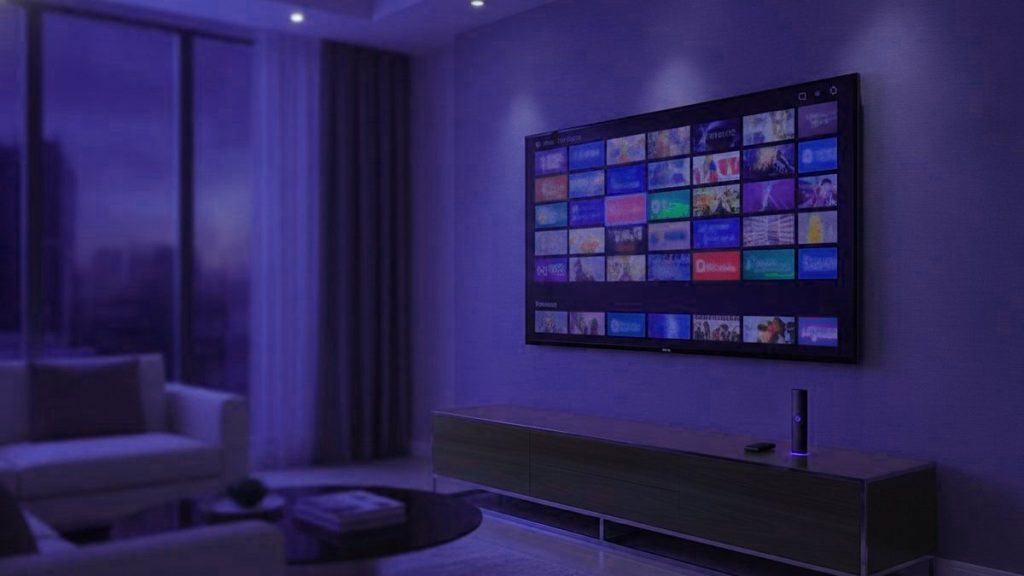
Rather than reaching you down a coaxial cable, off a rooftop aerial or from a satellite dish, IPTV delivers television through the same broadband line you already pay for. Sign in through a player app with the details your provider issues, and each channel shows up as ordinary internet data, no differently from the video on a FaceTime call. That is genuinely all there is to the idea. The material that follows is what separates a service you are glad you bought from one you quietly regret.
In one sentence
Old-fashioned broadcasting fires every channel at every household nonstop; IPTV waits until you ask, then streams the single channel you picked to you alone. Nearly every other trait of the technology is downstream of that one distinction.
What happens when you press a channel
Tap a channel and your app dials a server, which starts feeding back that one stream and nothing besides, sliced into short numbered segments of a few seconds each. Before a single frame appears, the player quietly gathers a handful of those segments, and it keeps topping up the pile the entire time you are watching, playing out of that little stockpile.
That stockpile is what everyone calls the buffer, and once you grasp it, almost every gripe about IPTV suddenly makes sense. Keep it full and the picture stays clean. Let the line wobble or the server get swamped, though, and the buffer empties quicker than it can be replenished — the moment it runs dry, playback halts. So buffering is not a channel falling over; it is simply the player sitting idle, waiting on segments that have yet to show up.
Why two houses get different results
Take two homes in Vancouver on the exact same Telus or Shaw plan and they can end up with wildly different results from one identical service — and the broadband is seldom what is to blame.
- How crowded each server is. An operator who undercuts the whole market has skimped on capacity, and that shortfall announces itself the second a Leafs game gets going. Nothing at your end changed; there are just more people ahead of you in the line.
- Whether a channel carries backup bitrates. Offer Hockey Night in 4K, HD and SD and there is always a lower rung to step down to. Ship it at a single bitrate and it is all-or-nothing.
- How far away the server sits. A stream hauled across an ocean meets far more chances to be held up than one travelling only from Toronto to Montréal.
- What your line is actually doing at nine on a weeknight, which bears little relation to the figure printed on your Bell bill.
That is exactly why a quick trial on a quiet Monday morning tells you nothing. With their servers half-empty, every provider looks polished — which is the whole reason the smart move is to try one at the ugliest, busiest hour you can find.
Where it parts ways with Netflix
| Streaming services | IPTV | |
|---|---|---|
| What arrives | A catalogue of ready-made shows and films | Scheduled live channels, with a catalogue alongside |
| Live sport | Next to nothing | The single biggest draw for subscribers |
| Breaking news | Not really | Yes — feeds from several countries together |
| Programme guide | Doesn’t apply | Yes, the familiar channel grid |
Each answers a different need. Where a platform like Netflix is the modern video shop, IPTV stands in for a cable or satellite package. And that is precisely why the households making the switch tend to be the ones who were only clinging to Rogers or Bell for the hockey, the Blue Jays and the news in the first place.
What you actually need
A connection that stays steady. Figure on roughly 25 Mbps if you want 4K, and around 10 for HD. What matters is steadiness rather than a big headline speed, because the buffer is bothered by the dropouts, not the average. If the Wi-Fi is feeble over by the TV, a cheap Ethernet adapter clears up more grief than any other single tweak.
Something to run the player on. A Samsung or LG smart TV from 2016 onward, an Apple TV, an Android box, a Fire TV Stick, a laptop, or a MAG or Formuler unit will all do the job — odds are one is already in the house, picked up from Best Buy Canada or Amazon.ca.
The player app itself. For most people that means IPTV Smarters Pro or TiViMate. Both turn up completely bare, holding not one channel until you feed in a subscription — which is far and away the thing that trips people up on day one.
A subscription. This is the piece you pay for and the piece that dictates the quality. Everything sitting above it is commodity kit and no-cost apps.
The jargon, decoded
An Xtream Codes login boils down to three items: a server address, a username and a password. Most current players ask for precisely those and sort out everything else on their own. It is the simpler path, and the one we hand out as standard.
An M3U link packs those same credentials into one long web address tacked on as parameters, and it suits players such as VLC and Kodi that are built around a playlist file. Guard it the way you would a password, because in practice that is exactly what it is.
The EPG is your on-screen programme guide. Keeping it accurate across thousands of channels is tedious, never-ending work that wins an operator no headlines — which is the very reason that whether it is present quietly tells you how the whole outfit is run.
Is it legal?
As a technology it is completely legal and utterly ordinary; there is a fair chance your own phone company runs on it. The question with teeth is whether the particular provider actually holds the distribution rights for what it is selling, and in this market that is often impossible to judge from the outside. Our legality page tackles that head-on instead of brushing it aside.
Judging a provider
- A free trial — spent at a peak evening slot, never a sleepy morning.
- Prices out in the open. If you have to message to find out, you are being quoted a personal figure.
- Refund terms in writing, with an actual number of days attached.
- Support that replies before you have paid. Whatever it is like now is as good as it gets.
- A proper website. Sellers who live entirely inside a single social media profile can disappear overnight, and plenty do.
You will find ours on the pricing page and the trial page; hold us to precisely the same standard you would set for anyone else. With a login in hand, the setup guides walk through each device, and the trip from paying to your first channel is usually done inside fifteen minutes.
Frequently asked questions
How does IPTV actually work, in plain terms?
Channels get grabbed by a provider, squeezed into internet-friendly video streams and parked on servers. When your player signs in with its server address, username and password and calls up a channel, that single feed is sent to you and nobody else. Picture an ordinary YouTube clip, only aimed at live television, and you have the whole trick.
Isn't IPTV just Netflix or YouTube TV under another name?
Under the hood, yes, all three carry television over internet protocol. The gap is that Netflix and YouTube TV are walled gardens, each with its own app and its own licensed library, whereas an IPTV login stays open and drops into whatever compatible player you fancy, carrying far more live channels. And no, a plan never bundles Netflix itself, only the occasional title that also happens to sit in Netflix's catalogue.
Do I have to buy a box to watch?
Not in the slightest. Anything that runs a player app will serve: a Samsung or LG smart TV, an Apple TV, an Android box, a Fire TV Stick, an iPhone, an Android handset, a Windows laptop or a Mac. Purpose-built units such as Formuler or MAG are entirely optional, picked up mainly for a tidier remote and guide.
How fast does my connection need to be?
Roughly 8 Mbps keeps one HD stream content, and about 25 Mbps covers a single 4K feed; set aside close to 30 Mbps if two televisions run at once. A rock-steady line counts for more than a big advertised figure, and wiring Ethernet straight to the TV device clears away most of the freezing that Wi-Fi throws up.
Why do the free IPTV lists always die off?
A free M3U link is one account being passed around thousands of strangers at once. The server either locks it out or simply cannot feed everybody, so channels fall over within days and whatever hangs on seizes up the second something popular airs. Paying buys you a private account on servers built for peak-hour crowds, which is exactly what your money is for.
So is IPTV legal in Canada?
The technology is lawful everywhere, and licensed platforms such as YouTube TV and CBC Gem are IPTV themselves. What genuinely matters is whether a given provider actually owns distribution rights for what it carries, and that varies from one to the next. In Canada, enforcement leans on operators, while the notice-and-notice system means a viewer can receive a forwarded warning. Our legality guide walks through where things actually stand.
Catching the hockey this weekend?
One WhatsApp message and your subscription is live under 15 minutes — priced in US dollars, no contract, and 7 days to change your mind.
Related articles
IPTV Glossary: 28 Terms Explained Before You Buy
Twenty-eight IPTV terms explained in plain English, from M3U links and Xtream Codes logins to EPG, catch-up, bitrate, HEVC and resellers, grouped…
19 September 2026IPTV vs Cable in 2026: Cost, Channels, Contracts and Reliability
A side-by-side look at IPTV and cable TV for Canadian homes: what each really costs per month, channel counts, picture quality, contracts…
19 September 2026IPTV vs OTT Streaming: The Real Difference, and Why Homes Keep Both
What actually separates IPTV from OTT streaming: private networks versus the open internet, live channels versus libraries, where subscription IPTV sits between…